
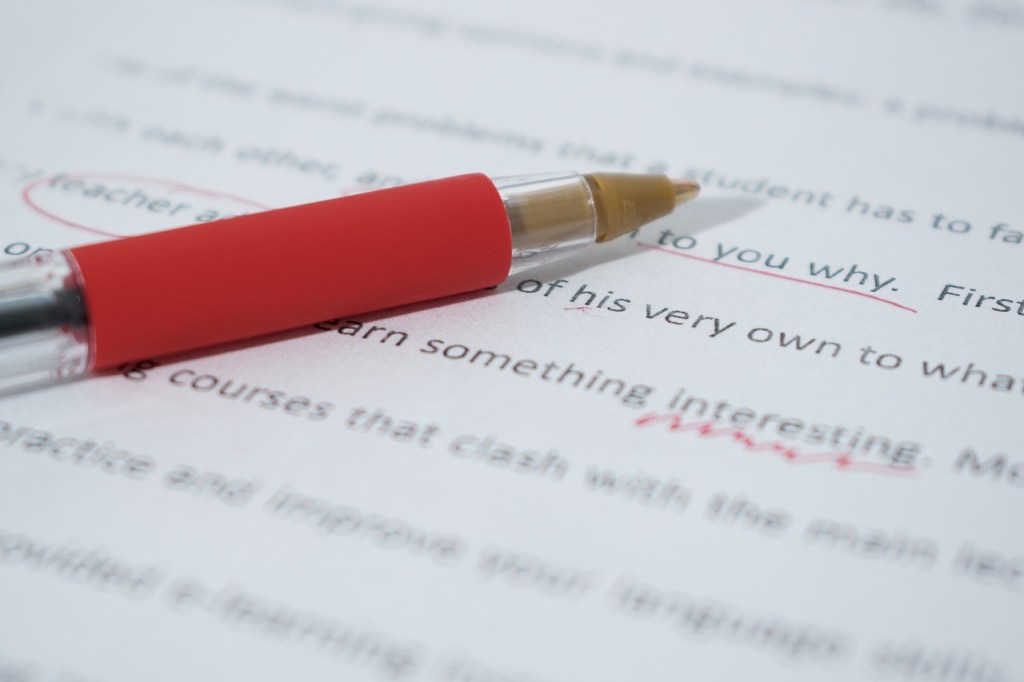
Relying on your grammar checker? Even if you’ve gone for a premium version like the much-overhyped Grammarly, you should make a point of checking whether the things it suggests are correct. They very often aren’t – and they seem to catch out people who should know better.
Apart from recommending things that are wrong, grammar checkers are perfectly capable of overlooking incorrect spelling and grammar. So, although they can be helpful, you should never completely rely on them no matter how much they tout buzzwords like “AI” and promise you perfection.
I’ve been making a little collection of oddities and anomalies in the course of my work and they serve as good examples of the vagaries you should expect to encounter. I threw in a little extra research, and I have to say there’s a whole can of worms there. Don’t worry, I won’t feed you all of them! Let’s dive in and check out the top 5 wiggly monsters – the ones I spotted on my own.
1. Incorrectly Suggesting the Use of Compound Words
In my post on tech jargon, we touched on phrasal verbs, and grammar checkers are very bad at spotting them. Instead, they’re only too eager to recommend switching to the compound word which is often a noun.
Language is changing, and I frequently wonder whether phrasal verbs will die out. Perhaps grammar checkers will be to blame. That’s because I’ve encountered multiple instructions reading “Login to your account” when the correct one should be “Log in to your account.”
“Corrections” that could be incorrect depending on context include seeing suggestions to use “Followup” instead of “follow up”; “Backup” instead of “back up”; and “playback” instead of “play back.” Tip: if you’re using these words to indicate something to do, you probably want the phrasal verb or dual word form.
I’m going to assume that in some instances, compound words are recommended just because they’re commonly used. I once wanted my readers to see if other appliances around the house work. The suggestion “housework” popped right up.
Unfortunately, a lot of people aren’t confident enough to ignore their grammar checker when it proposes an incorrect but familiar compound word. The result of that is a lot of incorrect compound word usage, and once you’re sensitised to it, you’ll see it just about everywhere.
2. Comma Complications and Punctuation Problems
Grammar checkers aren’t great at punctuation: a complication that may dismay those who aren’t confident with colons or commas. As for the dreaded semicolon, which grammar checkers seldom suggest, I’m going to assume that they don’t know what to do with them at all.
Grammarly, in particular, is overconfident with commas, often peppering them into texts unnecessarily. As far as I can see, there are two reasons why it does this: being unable to identify independent clauses, and its dedication to the Oxford comma. The latter may be less of a problem, but the former is a real headache.
Then, there are the commas that Grammarly doesn’t like. Once again, it’s sometimes right, but often wrong. For example, it seems this software doesn’t fancy seeing commas before subordinate clauses even though this choice is not always a wrong one.
3. Sometimes Insisting on Articles When it Sees a Noun
Slavishly following the recommendations of a grammar checker means you might say things in very awkward ways. Grammar checking software doesn’t always insist on articles before nouns, but for some reason, it sometimes does. For example, “Travelling at speed,” when used in a longer sentence, might prompt it to suggest the addition of “a” or “the.”
I’ve become so accustomed to ignoring these suggestions that I don’t have a handy example to show you, but the point is that AI-driven or not, grammar checkers are dumb enough to struggle with relatively simple sentence structures.
4. Sometimes Suggesting Nonsensical Corrections
Sometimes, I have no idea what AI’s reasoning is when it suggests “corrections.” At others, I can see where it is coming from, even though it’s wrong.
For example, saying “You rehearsed your lines well and the big moment has come,” initially led to a suggestion that I change “come” to “came.” In this iteration, the grammar checker wants me to switch “rehearsed” to the present tense. Clearly, it doesn’t like the switching of tense within my sentence, even though it is a “that was then and this is now” statement and there’s nothing wrong with it. By the way, do you see those two words in bold text? Apparently that’s wrong and I should have used “I don’t.” Yeah right.
5. Missing Genuine Errors
Yes, grammar checkers do miss genuine errors. This makes them particularly dangerous in the hands of the overconfident – or overly trusting. After all, everybody makes mistakes. That’s why we use grammar checkers. But grammar checkers, though their marketers love to spout catchphrases like “elevate your writing,” are very far from perfect.
Since I’m very opinionated and aware of it, I did some research on grammar checkers to see what other people have to say. I found that a 2020 study compared three major grammar checkers. At the time, they missed between 5 and 30 percent of errors altogether, and offered incorrect suggestions about as often. Are they much better now? I’m inclined to think that they aren’t.
Should You Ditch Your Grammar Checker?
Full disclosure: I have Grammarly, and I use it. It can be helpful – as long as you know what you’re doing and don’t take everything it says as gospel. Be willing to distrust it enough to do your own thinking, and you’ll be good to go. I’d like to leave you with a final thought.
Why Do We Fear/Respect AI So Much When it Can’t Even Check Grammar?
Few people seem to feel neutral about AI. Some are genuinely afraid that it will take over the world and replace us all. Others are terribly excited about it and seem to think that AI and machine learning will usher in a new era in which… Well, I’m not quite sure what they think this new era will consist of, but they do seem to believe in it. And, people must be buying into it, because the letters “AI” seem to have become a huge selling point for tech-related products.
I’m not afraid, and I’m not convinced. I do think AI will get better over time. It may even become smart enough to come up with original thoughts which may be of value. Perhaps I will join the ranks of the fearful or the fans someday. But one thing is certain: with AI not even being able to check my grammar reliably , I’m not going to let it drive my car anytime soon!
 Evergreen Times
Leave a comment